Sunday, July 24, 2022

Natural gas

For a long time, advocates have praised natural gas as being "better than coal." That's still true: no argument from me! However, that's a pretty low bar. Coal creates all kinds of pollution from mining and burning it, and the impact on climate change is also large. So gas is better, right? Well, maybe.

First, extraction. While coal mining has a pretty bad reputation, researchers have also tied natural gas extraction to deaths of people near drilling sites and downwind. 

Second, emissions. An eight year study of gas emissions in the Boston area found that emissions were much higher than predicted by known usage patterns. This suggests that gas might be seeping out around pipelines, but more ominously in homes. 

On a semi-related note, in addition to the climate change impacts of air pollution, a study in India finds that smog hurts children's cognitive and academic performance. While pollution in India is likely worse than it is here, all damage is cause for alarm... and consider that 30 minutes with a two stroke leaf blower emits more carbon than a trip from Texas to Alaska in a pickup truck. Another study in Chile finds that particulate matter (a kind of air pollution) is associated with a small but significant increase in emergency room visits.

Finally, an interesting chart shows the sources of greenhouse gas emissions: about 3/4 are from energy, at least as of 2016.

Again, gas is definitely better than coal, but hopefully that isn't the comparison we continue to make. Remember, renewable sources are more than economic in many places: bringing them in makes profits and helps the environment. 

Monday, July 11, 2022

Rethinking the importance of food miles

A new article in Nature claims that the supply chain is responsible for a fairly large share of the emissions associated with food- as much as 19%, but the figure is 36% for vegetables and fruits. This runs counter to the more established wisdom from writers like historian James McWilliams that food miles matter little. This 2010 NYT editorial by Stephen Budiansky says that transportation accounts for 14% of the total energy consumed by the American food system. Clearly one big factor is exactly what counts in each number: are we including processing? Are we including transportation for the inputs such as fertilizer? (Not sure, but it seems like the Nature article might be.) 

As usual, Hannah Ritchie at Our World in Data provides an array of helpful stats, concluding that "eating local only slightly reduces your emissions." For a more general summary, Tamar Haspel has some words of wisdom: think first about your diet and second about where food comes from, and keep in mind that salad is silly. Not many calories or nutrients there: just more of a crunch experience for the global rich like many of us here in Baltimore.

Wednesday, June 29, 2022

Crops & meat prices jumping

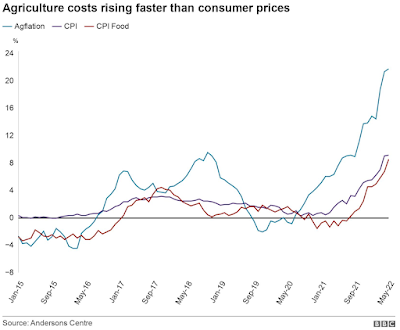
You would think that farmers would be excited about grain shortages: if Russia blocks Ukraine's exports, that raises the price for other exporters. Unfortunately shortages are all over input costs: fertilizer and gas are more costly than ever, and other factors are pushing the price of pork up, as shown in this BBC news article from today (June 29, 2022).

Agricultural CPI rising sharply over the past two years

As the above chart shows, the trend is just gathering steam: in September 2021 Bloomberg reported on low inventories of beef, pork, and chicken. I don't have an update on inventories, but it seems the pressures are still strong.


Maryland crabs

Uh oh! Today's Baltimore Sun reports that the crab population is under threat, and that harvesters will be limited in how much they can harvest and sell. This apparently is linked to the winter dredge survey, which reported in mid-May that the crab population is at its lowest level in the past 30 years.

The DNR is at pains to avoid pointing fingers, but the obvious causes include nearby agriculture, including fertilizer runoff from horticulture (mostly corn & soy) and fertilizer runoff from chicken farming. Importantly, much of the runoff is from upstream states- Maryland deals with waste from the other five states in the watershed....


Wednesday, June 22, 2022

Lab-grown meat

Just saw this article, posted September 2021, on many reasons why we shouldn't expect to see lab-grown meat any time soon. Although venture capitalists continue to fund it, most likely it will take many years before anything is available at scale. 

This is a good example of why I discourage people in my Resources class from writing about new technologies. If the engineers are still trying to get the technology to work, or if it's not financially sustainable on its own yet, economists generally don't want to go there. We just can't analyze the economics of a technology that's not "economic" yet. Maybe the advances in technology will come fast and furious and it will be economic soon, which would be fantastic! Then again, that might never happen. Just save the economic analysis for technologies that are at least close to being economic. 

Saturday, June 18, 2022

Gas taxes

Can you... Pigou?

The RFF's Daniel Raimi encourages states to take the windfall tax revenues and put them to good use. In Alaska and New Mexico, oil was taxed and the proceeds put into a rainy day fund. On the other hand, his counter-example is Appalachian states like West Virginia, where coal mining was never taxed, and where the economy continues to suffer. Maybe now, with the current high prices, Texas will finally be able to see its way clear to go ahead with the Medicaid expansion....

Tuesday, June 7, 2022

Yields of organic agriculture

Consumers are buying more and more organic produce. That's probably good for the environment, at least as far as improving biodiversity in the fields (as shown in a 2021 study in Switzerland and this 2022 meta-analysis) but that comes with losses in terms of yields. A 2021 study of growing grain in Sweden found that organic agriculture was 43%-72% as productive as conventional agriculture, and a 2021 meta-analysis concluded that on average, organic yields were about 75-80% of conventional plots. So maybe there are more bugs (good and bad both) in the fields, but it means that more fields will be required to produce the same amount of food. That also means higher prices for consumers, which will matter more for some consumers than others. Seems like the jury's still out.